
Best EMR for Peptide Clinics in 2026
Most EMR platforms weren't built for the recurring, protocol-driven model that peptide clinics actually run, creating costly gaps in patient adherence and missed cross-sell opportunities. This guide breaks down what to look for in 2026 and which platforms are actually worth your time.
Why Generic EMRs Fall Short for Peptide Practices
A traditional EMR was designed around the visit model: a patient comes in, a clinician documents the encounter, a claim is submitted. That workflow maps poorly onto peptide therapy, which is fundamentally a protocol model — patients follow multi-week injection schedules, log doses between visits, track biomarkers over time, and report wellbeing trends that only become meaningful across months of data.
When you try to run that model inside a generic EMR, the gaps are immediate. There's nowhere to track whether a patient actually injected BPC-157 on Tuesday. There's no dashboard showing which patients have gone quiet on their protocol. There's no way to correlate lab results with dose timing. Clinicians end up managing these gaps with spreadsheets, text messages, and tribal knowledge — which is both operationally fragile and, in most cases, a HIPAA liability.
The question for peptide clinics in 2026 isn't just "which EMR has the best charting" — it's "which platform was actually built for the way we operate."
What to Look For: Five Requirements That Actually Matter
1. Protocol-native dose tracking
Your EMR should understand that a peptide protocol has a schedule, and patients can be adherent or non-adherent to it. Look for platforms that let you define dosing protocols per patient, receive structured dose logs from patients, and flag when adherence drops below a threshold. If the software treats each dose log as a standalone note with no connection to an underlying protocol, it won't give you the operational visibility you need.
2. Biomarker trend views, not just lab file storage
Most EMRs let you attach a lab PDF to a patient record. That's not the same as being able to see that a patient's IGF-1 has been trending upward since starting Ipamorelin, or that their testosterone dipped in month three. Peptide clinicians need longitudinal biomarker views that can be compared against protocol start dates and dosing events — not a folder of PDFs.
3. Patient-facing mobile experience
Adherence in peptide therapy is heavily influenced by how easy you make it for patients to log doses and report how they're feeling. A patient portal that requires a desktop browser login is not the same as a mobile app with push-dose reminders, one-tap logging, and weekly wellbeing check-ins. The data you can act on is only as good as the data patients are willing to enter.
4. HIPAA compliance with a signed BAA
This is a hard requirement, not a nice-to-have. Any platform handling patient dose logs, lab results, and wellbeing data is handling protected health information (PHI). The vendor must sign a Business Associate Agreement. If they won't, using their product for clinical patient data is a HIPAA violation regardless of their marketing language. See our full guide to HIPAA for peptide practices for what to verify before signing a vendor contract.
5. Multi-patient monitoring at scale
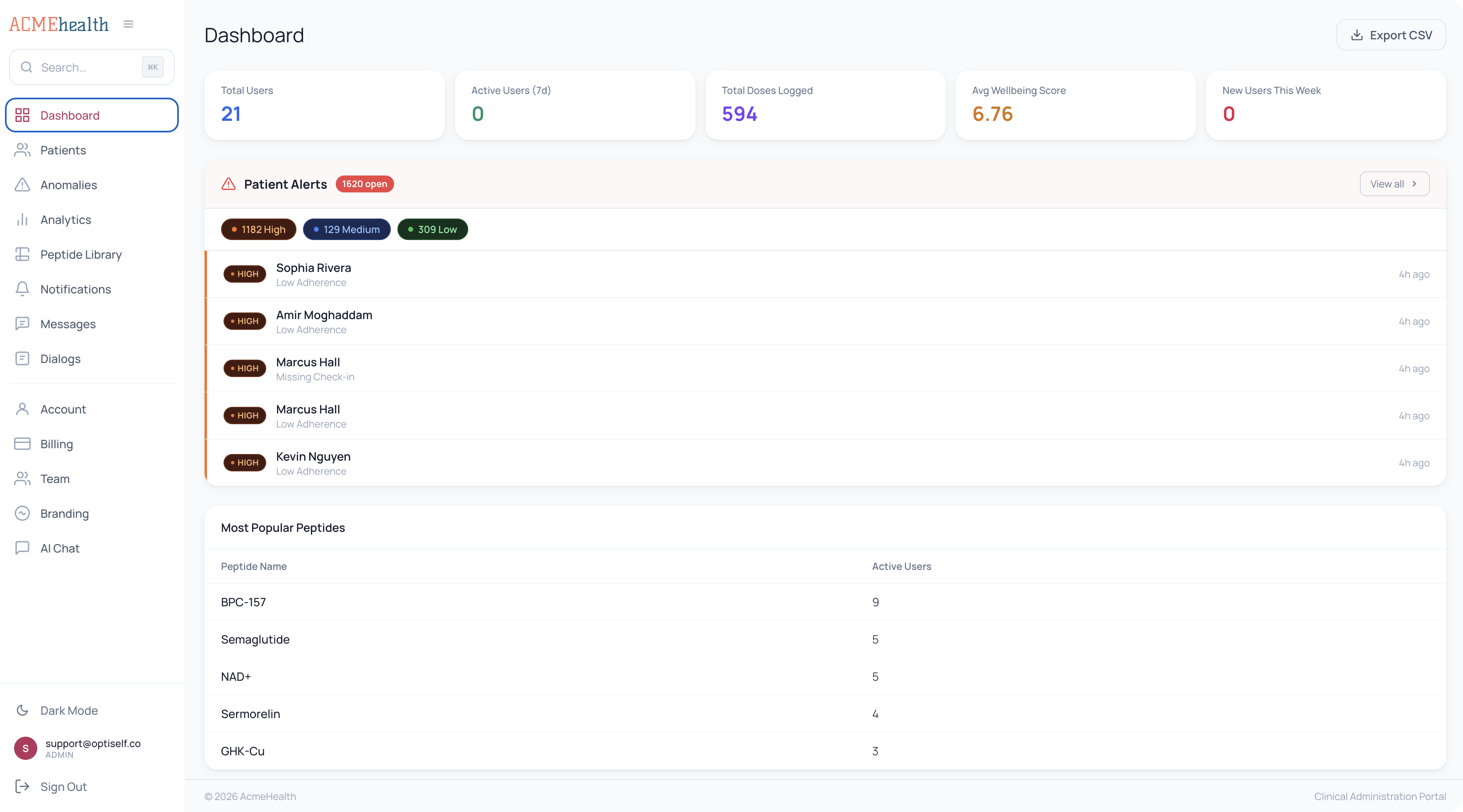
Solo practitioners can stay on top of 30 patients through memory and habit. Once you're managing 100+ active protocols, you need proactive alerts — which patients haven't logged a dose this week, which are due for labs, which have flagged low energy for three consecutive check-ins. That kind of population-level monitoring requires purpose-built anomaly detection, not manual chart reviews.
How Common EMR Platforms Stack Up
Charm EHR
Charm is one of the more flexible general EMRs and is popular in functional medicine practices. It handles charting, e-prescribing, and basic patient communication well. The gap for peptide clinics: no native protocol adherence tracking, no structured dose logging from patients, and biomarker trends require manual entry rather than structured data import. It's a reasonable choice if your practice is primarily visit-based with light peptide supplementation as a side offering — less ideal if protocols are your core business.
Jane App
Jane is widely used in wellness and functional health practices for its scheduling, intake forms, and clean practitioner UX. It doesn't natively support ongoing protocol management or patient-reported dose logs. Some clinics use Jane for scheduling and charting while patching adherence tracking together with separate tools — which creates the fragmented data problem rather than solving it.
SimplePractice
SimplePractice is built for therapy and mental health and has strong billing, notes, and client communication. It's not a fit for peptide clinics: no clinical lab tracking, no injection protocol management, and its patient-facing app isn't designed for structured health logging.
Purpose-built peptide platforms
A category of platforms has emerged specifically for the functional medicine and peptide therapy space, built around protocol management rather than billing-first clinical workflows. These typically offer structured dose logging, biomarker tracking, mobile patient apps, and population-level monitoring out of the box — the features that generic EMRs require workarounds to approximate.
The Real Cost of the Wrong Platform
EMR choice isn't just a software preference — it directly affects clinical outcomes and practice revenue. When adherence data lives in text messages and spreadsheets, clinicians miss the early signals that predict protocol dropout. When biomarkers aren't tracked longitudinally, the data to demonstrate outcomes doesn't exist, making it hard to justify premium protocol pricing or publish outcomes-based case studies.
The clinics growing fastest in the peptide space share a pattern: they've invested in infrastructure that makes adherence visible, makes outcomes measurable, and makes the patient experience seamless enough that word-of-mouth referrals compound over time. The platform you build on either enables that compounding or works against it.
Questions to Ask Before Committing to a Platform
- Will you sign a Business Associate Agreement for our clinical data?
- Does your platform support patient-reported dose logging from a mobile app?
- Can we define recurring injection protocols per patient and track adherence against them?
- Does your system support longitudinal biomarker tracking linked to protocol timelines?
- Do you have proactive alerts for patients who fall behind on adherence or check-ins?
- What does your data export look like if we need to migrate?
Any reputable vendor should be able to answer these directly. Vague answers about "customizable workflows" and "flexible charting" usually mean no.
OptyPeptides is built specifically for this
Protocol-native dose tracking, longitudinal biomarker views, a patient mobile app with push reminders, proactive adherence alerts, and full HIPAA compliance with BAA — designed for clinics where peptide protocols are the core product, not an afterthought.
Request a Demo